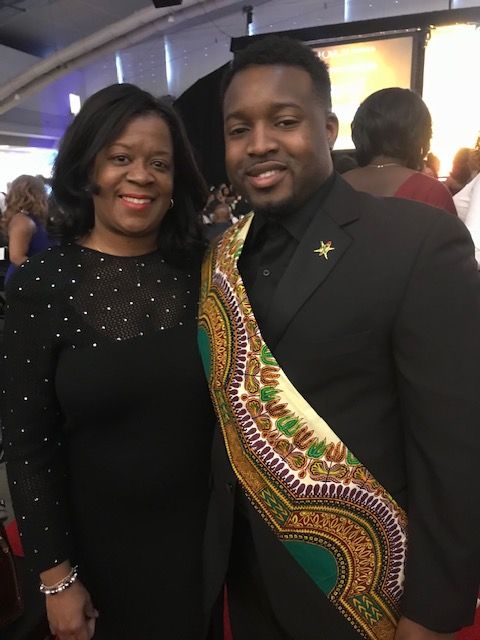
NSBE Lifetime Member Moves From Dean to Provost at Georgia Tech

Five years ago this month, NSBE celebrated the continuing rise of one of its outstanding academic and technical achievers. NSBE Lifetime Member Raheem Beyah, Ph.D., had recently become the second NSBE lifetimer appointed dean of the College of Engineering at the Georgia Institute of Technology — Georgia Tech. (NSBE National Advisor Gary S. May, Ph.D., now NSBE national advisor emeritus, became the first in 2011.)
Today, Beyah is overseeing the entire academic enterprise at Georgia Tech, after his appointment last November as provost and executive vice president for Academic Affairs.
Beyah was born in Atlanta, Georgia, and grew up there, raised primarily by a single parent, his mom. At Frederick Douglass High School, a public school in Atlanta, he made the commitment to fully apply his ample talent in math and science to build a successful career to benefit his family. Then he became an Aggie, taking on the undergraduate Electrical Engineering program at North Carolina A&T State University and joining the National Society of Black Engineers. After graduation, he took his N.C. A&T bachelor’s degree to Georgia Tech, where he earned his master’s and doctorate in Electrical and Computer Engineering and where he fully grasped the power of NSBE.
“NSBE has been part of every step of my academic journey,” Beyah says. “I am proud to be part of this organization and to represent this organization at Georgia Tech.”
Before becoming provost, Beyah served as dean of the College of Engineering and Southern Company Chair at Georgia Tech, where he led the College to top 10 national rankings across every engineering discipline. Before his deanship, he held several leadership roles at the Institute, including associate chair for Strategic Initiatives and Innovation in the School of Electrical and Computer Engineering, interim school chair, executive director of the online master’s in cybersecurity program and vice president for Interdisciplinary Research.
We recently asked Provost Beyah about his new post, how he arrived there and the work he intends to do.
Please tell us a little about your upbringing and how it shaped your career aspirations.
As a kid, I wanted to be an astronaut, and that early curiosity was nurtured by my grandmother, who introduced me to technology through video games and early computers. What felt like play at the time planted seeds that eventually grew into a career in engineering. Growing up less than five miles from Georgia Tech, I had no idea the Institute would play such a central role in my life. From an Atlanta kid to a leader at one of the state’s and the country’s premiere institutions, I have learned that success is not only about working hard but about being strategic and taking the time to build a strong foundation, especially for students adjusting to a new academic environment.
I attended Atlanta Public Schools growing up, and my experience as a student there showed me how access to opportunity can change what someone believes is possible. Every accomplishment I’ve had traces back to Atlanta Public Schools. My teachers and principals laid the foundation for everything I’ve been able to do. They showed up for us in ways that went far beyond the classroom, even when resources were limited. Throughout my life, mentoring has played a central role, with people seeing potential in me before I could see it in myself, creating an obligation that continues to guide how I support students, faculty and emerging leaders.
These experiences and that perspective shaped how I experienced Georgia Tech as a student, as a faculty member and as an academic leader, and it has shaped how I view access today.
Many are calling this a time of disruption of higher education in the U.S.A. Do you agree?
This is a moment of real transformation for higher education. Institutions like Georgia Tech have a responsibility to expand access to education and rethink how we prepare students for a rapidly changing world. I appreciate how Georgia Tech evaluates students in the context of the opportunities they had access to, because talent exists everywhere, including in rural communities and smaller schools, and when given the chance, those students consistently succeed.
Georgia Tech has evolved into a place where students from more backgrounds and more places can see themselves thriving. Creating an environment where people feel they belong and can fully succeed is work I am deeply committed to continuing. I am proud to be part of this work and to have the opportunity in my new role to continue to develop and expand these efforts.
The purpose of education goes beyond individual achievement. When students succeed academically and professionally, they bring that impact back to their families, their communities and the people coming behind them. That ripple effect is why access and opportunity matter so much.
What are your main goals and highest priorities in your new position?
Today, higher education is changing, and so are the questions we need to ask. As I look at my new role, I am focused on what it truly means to prepare students for the workforce and how we equip them to think critically in a world shaped by artificial intelligence and rapid technological change. We cannot simply add new tools to old models. We have to rethink how students learn, how they apply knowledge, how we support them as they prepare to navigate an increasingly complex professional landscape and how we reach all students with the opportunity to learn and become leaders in this ever evolving and more complex world.
Did your appointment as provost and executive vice president for Academic Affairs feel like a big leap, moving from leadership of engineering at Georgia Tech to leadership of academics broadly?
As I take on the responsibility of overseeing Georgia Tech’s academic enterprise, I see this is a tremendous challenge but also a deeply rewarding opportunity. If we get the answers right to continuing the improvement of learning opportunities and access to education, we have a chance to transform Georgia Tech as well as the city around us and the state beyond.
Legacy is about leaving a place better than you found it. What lasts is how many students can now see themselves in spaces they once thought were out of reach.